
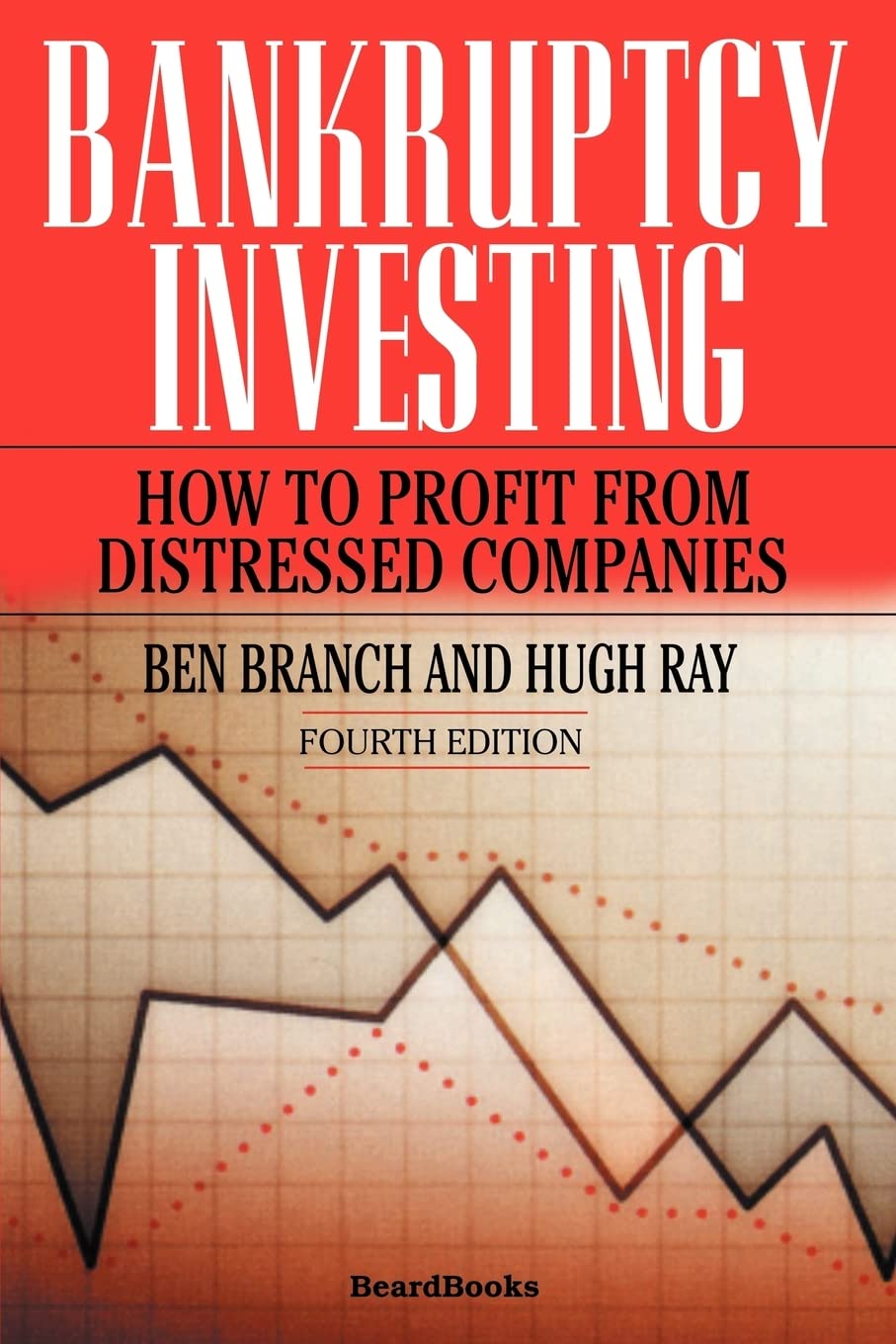
Bankruptcy Investing – How to Profit from Distressed Companies is worth considering for experienced investors who want a structured introduction to distressed assets, but not as a beginner-friendly promise of returns; Amazon lists it at $44.95 Bankruptcy Investing – How to Profit from…. Bankruptcy Investing covers capital structures, bankruptcy proceedings, valuation, and investor risks, while the available evidence does not establish a likely profit for any reader.
- The book has pages and was published on February 1, Bankruptcy Investing – How to Profit from….
- The book explains how bankruptcy affects corporations, capital structures, and potential investor profits from the bankruptcy process Bankruptcy Investing – How to Profit from….
- The NYU Stern description says the book covers identifying distressed assets and determining which fit an investor’s profile Books | Joseph Sarachek | The Distressed….
- Amazon lists the book at $44.95 Bankruptcy Investing – How to Profit from….
- Amazon says the book is available to ship in 1-2 days Bankruptcy Investing – How to Profit from….

What does Bankruptcy Investing – How to Profit from Distressed Companies cover?
Bankruptcy Investing – How to Profit from Distressed Companies explains how bankruptcy affects a corporation and its capital structure, and how investors might profit from the corporate bankruptcy process Bankruptcy Investing – How to Profit from…. The book is pages and was published on February 1, Bankruptcy Investing – How to Profit from….
Bankruptcy Investing also addresses how to identify distressed assets and decide which opportunities fit your investor profile Books | Joseph Sarachek | The Distressed…. That makes Bankruptcy Investing more useful as a framework for examining situations than as a simple list of trades. The listing does not establish that every strategy will suit you or produce a gain. Amazon lists the book at $44.95 and says it is available to ship in 1-2 days Bankruptcy Investing – How to Profit from….
What does investing in a bankrupt or financially distressed company involve?
Distressed debt investing means putting capital into the existing debt of a financially distressed company, government, or public entity What Is Distressed Debt Investing?. Bankruptcy Investing therefore involves more than buying ordinary shares after a dramatic price decline; the book’s stated scope includes security types, diligence materials, and portfolio management considerations Bankruptcy Investing: How to Profit from….
Bankruptcy Investing may present opportunities at several stages of a bankruptcy proceeding Bankruptcy Investing: How to Profit from…. Buying distressed assets or securities at lower prices can create opportunities, but the approach carries risk and requires research How to Profit from Bankruptcy: Investor’s Guide. Bankruptcy Investing also requires you to distinguish an attractive price from a business or claim whose underlying problems remain unresolved. The supplied evidence describes the process and its risks, but it does not provide a guaranteed return or a universal method for selecting securities.
How can investors gain exposure to a company in bankruptcy?
Investors can gain bankruptcy exposure through trade claims, distressed debt, bonds, and equity-related positions described in the supplied sources. The book covers buying and selling trade claims and accessing and dissecting bankruptcy filings Books | Joseph Sarachek | The Distressed…. Bankruptcy Investing can therefore involve studying the claims themselves rather than only purchasing common stock.
Bankruptcy Investing may also involve buying part of a successful but debt-troubled company’s debt with the goal of gaining a controlling position What Is Distressed Debt Investing?. Investment groups may buy large stakes in the debt and bonds of Chapter companies before new shares are issued, positioning themselves for post-bankruptcy shares How to Profit from Bankruptcy: Investor’s Guide. Bankruptcy Investing requires attention to priority: term loans are contractually senior to bonds and are paid first in bankruptcy What Is Distressed Debt Investing?. The ledger does not establish that any particular security will recover value.
What happens to common stockholders in Chapter versus Chapter 11?
Chapter is the liquidation chapter: the company stops operating, a trustee liquidates or sells assets, and proceeds are distributed to creditors Bankruptcy | Investor.gov What is the difference between bankruptcy cases…. Chapter allows a corporation to reorganize without liquidating all assets; the debtor usually remains in possession, may continue operating, and may borrow with court approval What is the difference between bankruptcy cases… Chapter – Bankruptcy Basics.
Bankruptcy Investing in common stock is especially exposed to the priority structure. Public companies typically cancel original shares and issue new shares for agreed equity distributions How to Profit from Bankruptcy: Investor’s Guide. Existing stockholders usually receive nothing or next to nothing, and common shareholders are frequently replaced by new shareholders under a Chapter plan How to Profit from Bankruptcy: Investor’s Guide Bankruptcy | Investor.gov. Bankruptcy Investing analysis should also account for the fact that equity holders may vote on a Chapter plan and may file a proof of interest rather than a proof of claim Chapter – Bankruptcy Basics. Personal assets generally remain outside the corporation’s bankruptcy risk Chapter – Bankruptcy Basics.
How can investors evaluate a bankrupt company before investing?
Investors can begin by researching fundamentals and looking for a viable reorganization plan that addresses core problems and reduces operating costs How to Profit from Bankruptcy: Investor’s Guide. Bankruptcy Investing also calls for valuing potential assets for purchase and creating a liquidation analysis Books | Joseph Sarachek | The Distressed…. A Chapter disclosure statement must provide information about assets, liabilities, and business affairs sufficient for creditors to judge the plan Chapter – Bankruptcy Basics.
Bankruptcy Investing research may be limited to public financial records when due-diligence access is restricted What Is Distressed Debt Investing?. The supplied case evidence shows why valuation assumptions matter: unsecured creditors would receive a distribution only if enterprise value exceeded a $317 million debt hurdle Bankruptcy Court highlights comparables…. One expert estimated enterprise value at $335 million to $445 million, with a midpoint of $390 million, while another estimated $180 million to $220 million, with a midpoint of $200 million Bankruptcy Court highlights comparables…. Bankruptcy Investing valuation used discounted cash flow and comparable-company analyses Bankruptcy Court highlights comparables…, and a reviewer says a one percent discount-rate change can materially affect valuation How to Profit from Distressed Companies (2nd….
What are the risks and potential returns of Bankruptcy Investing?
Bankruptcy Investing is described as highly volatile and potentially highly lucrative Books | Joseph Sarachek | The Distressed…. The NYU Stern description says distressed investors can sometimes earn one-hundred times their invested capital Books | Joseph Sarachek | The Distressed…. That figure is a stated possibility, not a typical or expected result, and the ledger supplies no direct comparative performance figure for financially healthy companies.
Bankruptcy Investing can fail when the problems that caused the bankruptcy remain and the scenario repeats after the proceeding How to Profit from Bankruptcy: Investor’s Guide. Distressed debt investments may be difficult to execute, and investors may lack complete financial information because due diligence can be limited to public records What Is Distressed Debt Investing?. Bankruptcy Investing is described by one reviewer as high-level investing unsuitable for beginners or novices How to Profit from Distressed Companies (2nd…, while another highlights uncertainty from the adversarial legal process How to Profit from Distressed Companies (2nd…. The evidence supports substantial uncertainty alongside unusually high stated upside, not a reliable advantage over healthy companies.
How can an investor buy bankruptcy-related securities, and what costs or account requirements apply?
Investors may encounter bankruptcy-related exposure through distressed debt, bonds, trade claims, or equity-related positions. The book covers buying and selling trade claims and working with bankruptcy filings Books | Joseph Sarachek | The Distressed…. Bankruptcy Investing can also involve investment groups buying debt and bonds in Chapter companies before new shares are issued How to Profit from Bankruptcy: Investor’s Guide.
Bankruptcy Investing does not come with published account instructions in the supplied sources. The available evidence does not state brokerage-account requirements, transaction costs, minimum account sizes, or a general purchase procedure. Those details are unavailable here, so you should not infer them from the book’s subject matter. Bankruptcy Investing also requires comparing the position of debt instruments: term loans are contractually senior to bonds and are paid first in bankruptcy What Is Distressed Debt Investing?. That priority describes ranking in bankruptcy, not a promise that a purchase will be accessible or profitable.
Can an individual in Chapter bankruptcy buy or sell investments?
Chapter applies to an individual with regular income who believes debts can be repaid within a reasonable time What is the difference between bankruptcy cases…. Under Chapter 13, a debtor may propose paying a percentage of future income to the bankruptcy trustee, and court approval places the debtor under court protection while debts are repaid What is the difference between bankruptcy cases….
Bankruptcy Investing rules for a Chapter debtor’s personal purchases or sales are not supplied here. The sources do not state whether a debtor may freely buy or sell investments, which approvals particular trades require, or what reporting applies. Bankruptcy Investing should therefore not be treated as permission to trade during Chapter 13. Bankruptcy Investing decisions in that situation require information beyond this ledger; the review cannot infer an approval requirement, an exemption, or a reporting duty that the supplied sources do not state. The available material describes Chapter 13’s repayment structure, not investment-trading procedure.
If a company you own files for bankruptcy, should you sell or hold?
Shareholders should first identify whether the filing is Chapter liquidation or Chapter reorganization because the company’s operations and asset treatment differ Bankruptcy | Investor.gov What is the difference between bankruptcy cases…. Bankruptcy Investing analysis should then examine the reorganization plan, disclosure statement, capital structure, assets, liabilities, and possible recovery How to Profit from Bankruptcy: Investor’s Guide Chapter – Bankruptcy Basics.
Bankruptcy Investing does not support a universal sell-or-hold instruction. Public companies typically cancel original shares and issue new shares for agreed equity distributions How to Profit from Bankruptcy: Investor’s Guide, while stockholders usually receive nothing or next to nothing How to Profit from Bankruptcy: Investor’s Guide. Common shareholders are frequently replaced by new shareholders under a Chapter plan Bankruptcy | Investor.gov. Bankruptcy Investing decisions should therefore be based on the company-specific plan and evidence, not on the label alone. The supplied sources provide no company-specific recovery calculation, so this review cannot tell you to sell or hold a particular stock.
What do buyers say about Bankruptcy Investing?
Buyer and reviewer comments present Bankruptcy Investing as advanced material rather than a beginner guide. One Amazon reviewer describes investing in bankrupt firms as high-level investing that is not for beginners or novices How to Profit from Distressed Companies (2nd…. Another Amazon reviewer emphasizes uncertainty arising from the adversarial nature of the legal process How to Profit from Distressed Companies (2nd….
Bankruptcy Investing also receives a broader description in a Goodreads review, which says the book covers security types, diligence materials, and portfolio management considerations Bankruptcy Investing: How to Profit from…. A separate Goodreads review says the book addresses creditors in each credit class and their incentives when approving or rejecting distributions from the bankrupt estate Bankruptcy Investing: How to Profit from…. Bankruptcy Investing appears to be positioned as analytical and legally involved, but these statements are reviewer opinions, not measurements from independent testing. Bankruptcy Investing may fit a reader seeking subject coverage, while the supplied reviews do not prove that the book will improve investment results.
Pros and Cons
Pros
- Addresses distressed-asset identification and fit with an investor’s profile Books | Joseph Sarachek | The Distressed….
- Covers security types, diligence materials, and portfolio management considerations Bankruptcy Investing: How to Profit from….
- Includes buying and selling trade claims and analyzing bankruptcy filings Books | Joseph Sarachek | The Distressed….
- Covers asset valuation and liquidation analysis Books | Joseph Sarachek | The Distressed….
Cons
- The subject is described by a reviewer as high-level investing that is not for beginners or novices How to Profit from Distressed Companies (2nd….
- Distressed investing can be highly volatile and difficult to execute Books | Joseph Sarachek | The Distressed… What Is Distressed Debt Investing?.
- Investors may lack complete financial information because due diligence can be limited to public records What Is Distressed Debt Investing?.
- The supplied sources do not provide brokerage requirements, transaction costs, minimum account sizes, or a general buying procedure.
- The book’s listing date is February 1, 2007, which may limit how directly its material maps to a current case Bankruptcy Investing – How to Profit from….
Final Verdict
Key Takeaways
- Treat the book as an overview of distressed investing and bankruptcy analysis, not as a guarantee of returns.
- Distinguish Chapter liquidation from Chapter reorganization before assessing a stock or debt position.
- Review the disclosure statement, capital structure, valuation, debt hurdle, and proposed recovery before investing.
- Assume that brokerage requirements, transaction costs, minimum account sizes, and Chapter trading rules are unavailable from the supplied sources.
- The book appears better suited to experienced readers than beginners, based on the cited reviewer comments.
Frequently Asked Questions
What is the 7% rule in investing?
The supplied ledger does not define a 7% rule in investing. No explanation, calculation, or source for that rule is available in the provided material.
Do you have to pay back investors if your business fails?
The supplied sources do not answer whether you must repay investors when a business fails. The ledger discusses bankruptcy priorities and distressed debt, not a general repayment rule for business investors.
Can I buy stock while in Chapter 13?
The supplied sources do not state whether a Chapter debtor may freely buy stock, what approvals are required, or what reporting applies. They only describe Chapter repayment and court protection What is the difference between bankruptcy cases….

Should I sell my stock if a company files Chapter 7?
You should not apply a universal sell instruction from the supplied evidence. Chapter stops operations and liquidates assets to pay debts Bankruptcy | Investor.gov, while stockholders usually receive nothing or next to nothing in the described bankruptcy outcomes How to Profit from Bankruptcy: Investor’s Guide.
Sources
- Bankruptcy Investing – How to Profit from Distressed Companies (2026-10-19)
- Bankruptcy Investing – How to Profit from Distressed Companies: Branch, Ben, Ray Esq., Hugh: 9781587982910: Amazon.com: Books
- Books | Joseph Sarachek | The Distressed Investing Playbook: How the Smart Money Profits When Companies Fail and Markets Go Haywire (2025-06-09)
- What Is Distressed Debt Investing? (2021-08-05)
- Bankruptcy Investing: How to Profit from Distressed Companies by Ben Branch
- How to Profit from Bankruptcy: Investor’s Guide (2006-06-18)
- Bankruptcy | Investor.gov
- What is the difference between bankruptcy cases filed under chapters 7, 11, and 13?
- Chapter – Bankruptcy Basics
- Bankruptcy Court highlights comparables selection in assessing experts’ valuations
- How to Profit from Distressed Companies (2nd Edition): Branch, Ben, Ray, Hugh: 9781587981210: Amazon.com: Books
Disclosure: As an Amazon Associate, I earn from qualifying purchases.