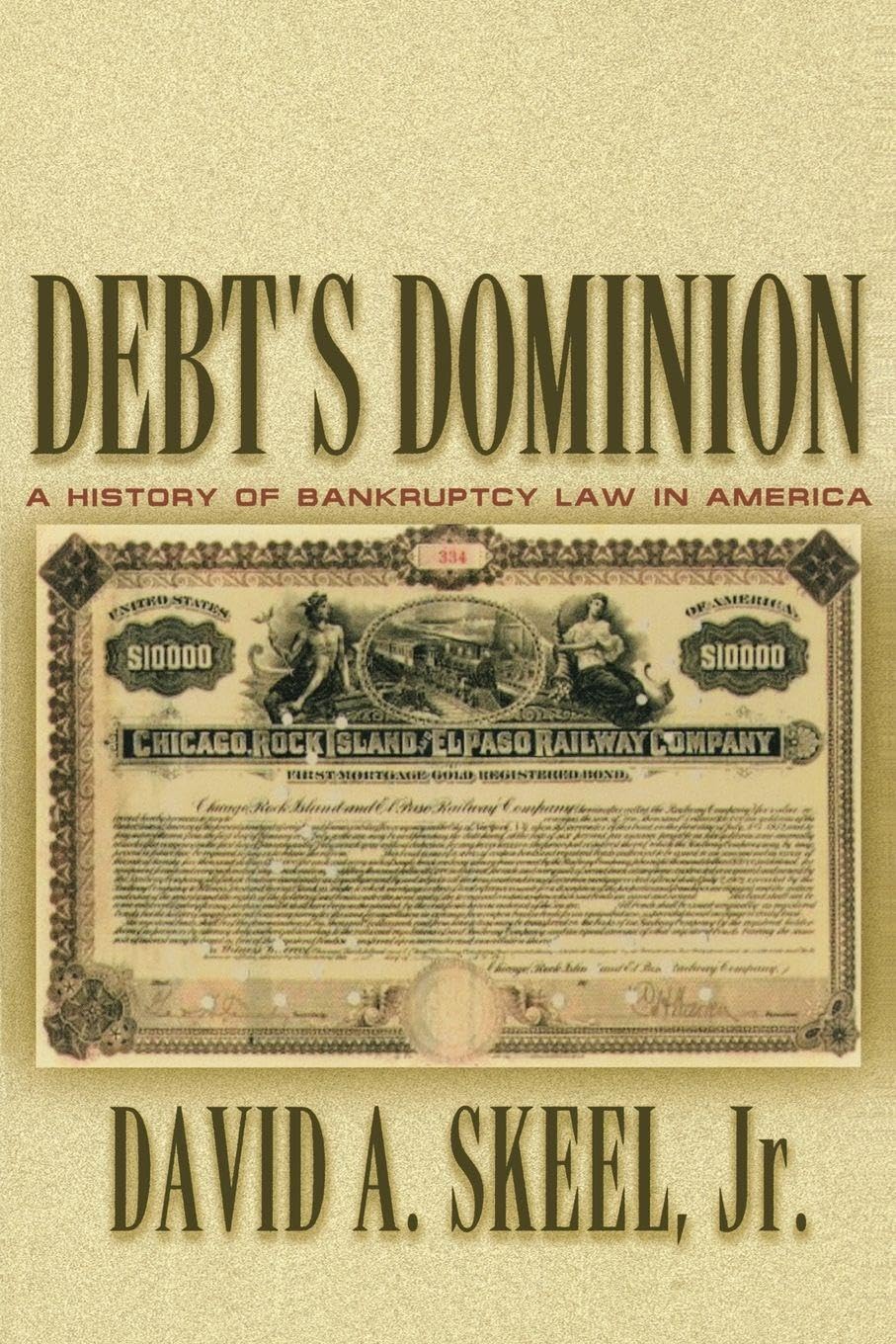
Debt’s Dominion is worth buying for readers who want a political history of American bankruptcy law, with the Amazon listing showing a price of $50. David A. Skeel wrote the book, which covers the subject from to the present, but the available evidence cannot confirm its chapter structure, buyer-review consensus, or usefulness as filing guidance Debt's Dominion: A History of Bankruptcy Law in… Debt's Dominion: A History of Bankruptcy Law in….
- David A. Skeel wrote Debt’s Dominion Debt's Dominion: A History of Bankruptcy Law in….
- Princeton University Press published the book in according to the bibliographic source Debt's Dominion: A History of Bankruptcy Law in….
- Amazon lists a 300-page English-language edition weighing ounces Debt's Dominion: A History of Bankruptcy Law in….
- Amazon lists the book at $50 and marks it In Stock Debt's Dominion: A History of Bankruptcy Law in….
- Amazon lists dimensions of x 0.75 x inches Debt's Dominion: A History of Bankruptcy Law in….

What is Debt's Dominion about, and who wrote it?
David A. Skeel wrote Debt’s Dominion: A History of Bankruptcy Law in America, according to the bibliographic evidence Debt's Dominion: A History of Bankruptcy Law in…. Debt’s Dominion examines the political dynamics behind the evolution of American bankruptcy law rather than presenting itself in the available evidence as a procedural filing manual Debt's Dominion: A History of Bankruptcy Law in….
For you as a prospective reader, Debt’s Dominion therefore appears best suited to historical and political inquiry. The supplied material supports that broad focus, but it doesn’t provide a chapter-by-chapter summary, detailed contents list, or buyer-review consensus. Those gaps matter: you can identify the book’s subject and author with confidence, but you can’t use the available evidence to judge every chapter or claim that readers broadly agree about its quality. The review can assess scope, publication details, and documented themes; it can’t recreate information the sources don’t provide.
When was Debt's Dominion published, and what period does it cover?
Princeton University Press published Debt’s Dominion in according to the bibliographic source Debt's Dominion: A History of Bankruptcy Law in…. The book traces American bankruptcy law from its beginnings in to the present day Debt's Dominion: A History of Bankruptcy Law in….
Amazon presents a different publication date for Debt’s Dominion: November 30, Debt's Dominion: A History of Bankruptcy Law in…. The sources therefore report conflicting publication details, and the available evidence doesn’t establish which date should replace the other. Amazon lists Princeton University Press as the publisher, English as the language, and pages as the print length Debt's Dominion: A History of Bankruptcy Law in…. The listing also gives an item weight of ounces and dimensions of x 0.75 x inches Debt's Dominion: A History of Bankruptcy Law in…. Those figures describe the listed edition, while the bibliographic source supplies the publication claim; you should treat the distinction as unresolved rather than as a settled edition history.
Which federal bankruptcy laws and court decisions shaped the history in the book?
The available evidence does not name the specific federal bankruptcy statutes or court decisions discussed in Debt’s Dominion. That limitation prevents a responsible list of major laws or cases.
Debt’s Dominion does document a political connection between a divided bankruptcy commission, the Republican takeover of Congress, and recent ideological battles over consumer bankruptcy Debt's Dominion: A History of Bankruptcy Law in…. That connection gives you a documented example of the book’s interest in institutions and political conflict, but it doesn’t identify every statute, judicial decision, or amendment involved. Debt’s Dominion can therefore be assessed here as a history of political forces, not as a source from which to reconstruct a complete case-law timeline. The missing names are important. Without them, the available evidence can’t support claims about which federal laws mattered most, how particular courts interpreted them, or how individual rulings changed consumer or corporate bankruptcy.
How did bankruptcy law change the balance between debtors and creditors?
Skeel identifies an organized creditor lobby, pro-debtor ideological currents, and an increasingly powerful bankruptcy bar as forces shaping American bankruptcy law Debt's Dominion: A History of Bankruptcy Law in…. That framing presents the debtor-creditor balance as a political result rather than as a simple, uninterrupted movement in one direction.
Debt’s Dominion describes American bankruptcy as giving corporate and individual debtors greater control over their fate than they have in most other countries Debt's Dominion: A History of Bankruptcy Law in…. The book also argues that American bankruptcy law reflects interaction among creditor lobbying, pro-debtor ideology, and the bankruptcy bar Debt's Dominion: A History of Bankruptcy Law in…. For you, Debt’s Dominion offers a way to understand changing influence through competing organized and ideological forces. The ledger doesn’t provide enough evidence for a precise comparison of individual legal rights at each historical stage, however. You shouldn’t infer a detailed rights chart, or assume that every debtor and creditor experienced the system in the same way, from the broad political description alone.
How did early American and modern federal bankruptcy procedures differ?
Debt’s Dominion characterizes American bankruptcy as an opportunity to recover rather than a debtor’s last gasp Debt's Dominion: A History of Bankruptcy Law in…. That description gives you the book’s stated purpose-oriented contrast, but it doesn’t supply a procedural comparison.
The documented historical range begins in and extends through the present day Debt's Dominion: A History of Bankruptcy Law in…. For Debt’s Dominion, that means early American law and modern federal bankruptcy appear within the same broad history, while the supplied evidence leaves the differences unavailable. The sources don’t specify early procedures, modern filing steps, eligibility rules, required documents, or exact changes between periods. Debt’s Dominion can therefore help frame bankruptcy as a possible route to recovery, but it shouldn’t be treated on this evidence as instructions for filing. You would need separate, current legal information for practical questions about forms, deadlines, eligibility, fees, and procedure; none of those details is provided in the ledger.
What role did the Constitution and Congress play in creating a national bankruptcy system?
Congress lifted the country’s first bankruptcy code from English law in 1800, according to the available historical claim Debt's Dominion: A History of Bankruptcy Law in…. That fact places congressional action at the documented starting point of the national bankruptcy system discussed by Debt’s Dominion.
Debt’s Dominion also connects a divided bankruptcy commission and the Republican takeover of Congress with ideological battles over consumer bankruptcy Debt's Dominion: A History of Bankruptcy Law in…. Congress therefore appears in the supplied evidence both as an early lawmaking institution and as part of later political conflict. The ledger doesn’t provide a specific constitutional provision, a court interpretation of that provision, or a complete timeline of congressional revisions. For that reason, Debt’s Dominion can be described here as documenting congressional and political roles without supporting a full constitutional history. You shouldn’t read the available claims as a complete account of how national authority was interpreted, challenged, or revised across every stage.
How does Debt's Dominion help explain bankruptcy rules and filing today?
Debt’s Dominion can give you context for modern consumer-bankruptcy debates by connecting legal change with political dynamics Debt's Dominion: A History of Bankruptcy Law in…. Its account also presents American bankruptcy as an opportunity to recover rather than a debtor’s last gasp Debt's Dominion: A History of Bankruptcy Law in….
That context has limits. Debt’s Dominion doesn’t provide current filing instructions, forms, eligibility requirements, fees, timelines, or legal advice in the supplied evidence. No named alternative books appear either, so a responsible product comparison cannot be made. Amazon lists the book at $50 and marks it In Stock Debt's Dominion: A History of Bankruptcy Law in…. The listing supplies specifications, including a 300-page print length, but no buyer rating or review claims are available in the ledger Debt's Dominion: A History of Bankruptcy Law in…. Debt’s Dominion is therefore a history-focused purchase for readers who want background on bankruptcy politics, not a substitute for current filing information or individualized legal guidance.
Pros and Cons

Pros
- The book examines the political dynamics behind the evolution of American bankruptcy law Debt's Dominion: A History of Bankruptcy Law in….
- Its historical scope runs from to the present day Debt's Dominion: A History of Bankruptcy Law in….
- The book identifies creditor lobbying, pro-debtor ideology, and the bankruptcy bar as forces shaping bankruptcy law Debt's Dominion: A History of Bankruptcy Law in….
- It presents American bankruptcy as giving corporate and individual debtors greater control over their fate than they have in most other countries Debt's Dominion: A History of Bankruptcy Law in….
Cons
- The supplied evidence doesn’t provide a chapter-by-chapter summary or specific list of statutes and court decisions discussed Debt's Dominion: A History of Bankruptcy Law in….
- The available information doesn’t provide filing steps, eligibility rules, forms, fees, timelines, or legal advice Debt's Dominion: A History of Bankruptcy Law in….
- Amazon’s publication date conflicts with the bibliographic publication date, and the supplied evidence doesn’t resolve the discrepancy Debt's Dominion: A History of Bankruptcy Law in…Debt's Dominion: A History of Bankruptcy Law in….
- No buyer rating or review claims are available in the supplied listing evidence Debt's Dominion: A History of Bankruptcy Law in….
Final Verdict
Key Takeaways
- Choose the book for a historical and political account of American bankruptcy law, not for filing instructions.
- Treat and November 30, as conflicting source-reported publication dates Debt's Dominion: A History of Bankruptcy Law in…Debt's Dominion: A History of Bankruptcy Law in….
- Expect coverage from to the present day, but not a statute-by-statute or case-by-case inventory Debt's Dominion: A History of Bankruptcy Law in….
- Amazon lists a 300-page English edition at $50 and In Stock Debt's Dominion: A History of Bankruptcy Law in….
Frequently Asked Questions
Who wrote Debt's Dominion?
David A. Skeel wrote Debt’s Dominion: A History of Bankruptcy Law in America Debt's Dominion: A History of Bankruptcy Law in….
When was Debt's Dominion published?
The bibliographic source says Princeton University Press published Debt’s Dominion in 2001, while Amazon lists November 30, 2003; the supplied evidence doesn’t resolve the discrepancy Debt's Dominion: A History of Bankruptcy Law in… Debt's Dominion: A History of Bankruptcy Law in….
What period does Debt's Dominion cover?
The book traces American bankruptcy law from its beginnings in to the present day Debt's Dominion: A History of Bankruptcy Law in….
How much does Debt's Dominion cost on Amazon?
Amazon lists Debt’s Dominion at $50 and marks it In Stock Debt's Dominion: A History of Bankruptcy Law in….
Does Debt's Dominion explain how to file bankruptcy today?
The available evidence does not provide current filing instructions, forms, eligibility requirements, fees, timelines, or legal advice. The book’s documented focus is political history Debt's Dominion: A History of Bankruptcy Law in….
Sources
Disclosure: As an Amazon Associate, I earn from qualifying purchases.